What is an abaya?
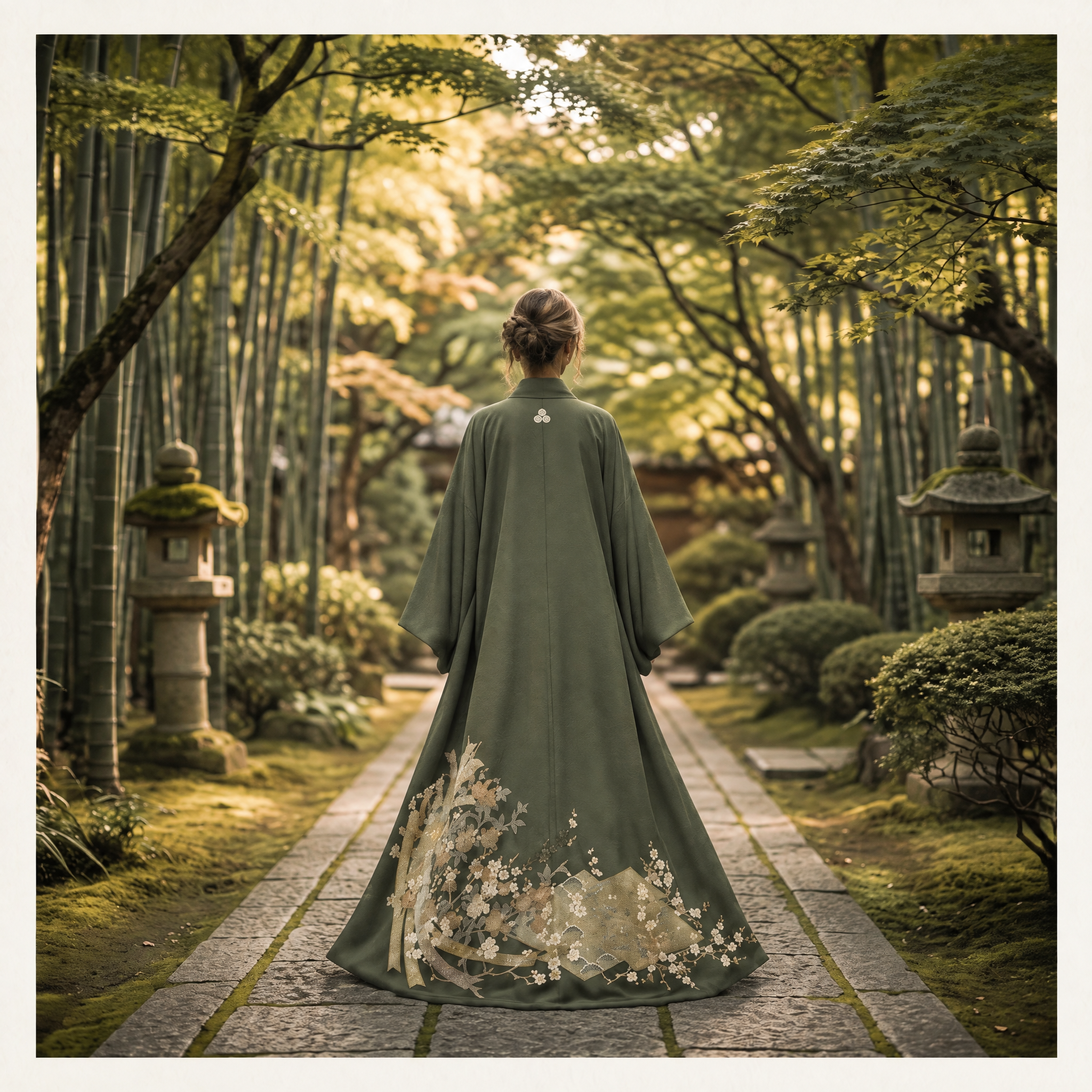
An abaya is a long, loose overgarment worn by Muslim women in the Middle East so that the lines of the body are not shown. It is usually black (colours have become more common in recent years), and in Saudi Arabia it is the established way for a woman to dress when she goes out.
What is a kimono abaya / kimono robe?
A kimono abaya is a garment made by unpicking a genuine vintage kimono — one actually worn in Japan — and re-tailoring it as an abaya. WATASI JAPAN works mainly with the kurotomesode — the most formal kimono a mother wears at a Japanese wedding — along with other vintage kimono such as komon, finished piece by piece, with care, by women artisans in Shirakawa, Fukushima. (→ more on kimono grades)
Abroad, cloth printed with Japanese-style patterns is sometimes sold as “kimono”. WATASI JAPAN uses only genuine vintage kimono. The kurotomesode’s structure — auspicious patterns on the hem of a black ground — sits naturally with the shape of an abaya or robe: a calm black plane, with silk embroidery and dyeing. The drape and sheen of the silk itself, which printed factory fabric cannot give, shift with every movement.
Wear Japanese Art.
Abaya, open abaya, kimono robe — the difference
| Shape | Character | Best for |
|---|---|---|
| Abaya (closed) | A long dress form, closed at the front, complete on its own | When you want a properly composed look; the whole outfit is set with this one piece |
| Open abaya | An overlayer open at the front; the clothes underneath show | When you want to vary the look with the colour or length of what’s underneath; easy for travel |
| Kimono robe | An overlayer that keeps the body and sleeves of the kimono; closer to a gown in length | A little more than loungewear — hotels, receiving guests, a short outing. Wearable even if modesty is not the aim |
The material and construction are the same for all (vintage kimono silk / one of a kind / made with care); you choose the shape by how you want to wear it. If in doubt, a semi-custom consultation can adjust the length, sleeves and front closure.
Note: WATASI JAPAN currently delivers these as the kimono robe (including abaya and open-abaya forms). For requests such as “I’d like an abaya” or “I want it closed at the front”, please ask about semi-custom.
The material — what genuine silk makes possible
The kurotomesode and other vintage kimono we use were made from fine silk to begin with. Because we unpick and tailor it, the material can be, if anything, more luxurious than buying new fabric. The longer the abaya or robe, the more the quality of the material shows in the silhouette.
- Antibacterial, odour-resistant — daily care is just airing in the shade
- Soft against the skin — silk is a protein close to human skin
- Excellent at absorbing and releasing moisture — stays dry even in humid places; well suited to the Middle Eastern climate
- Blocks UV / resists creasing — the Japanese cocoons used in vintage kimono resist creasing even better than overseas silk, with more firmness
Upcycling: giving life again to a kimono that has finished its role. A garment asleep in a drawer is reborn as clothing worn every day, somewhere in the world.
The patterns have meaning
The hem patterns of a kurotomesode were originally chosen to wish for “the prosperity of the house” and “the happiness of the child”. Pine-bamboo-plum, crane, chrysanthemum, peony — all auspicious patterns for long life, celebration and beauty; wishes that carry across countries and religions.
WATASI JAPAN removes motifs to be avoided under Islamic teaching — figurative images of people or animals — and selects mainly geometric, botanical and natural patterns. We check the pattern placement on every piece and tailor only those that can be worn regardless of religion or nationality.
Styling
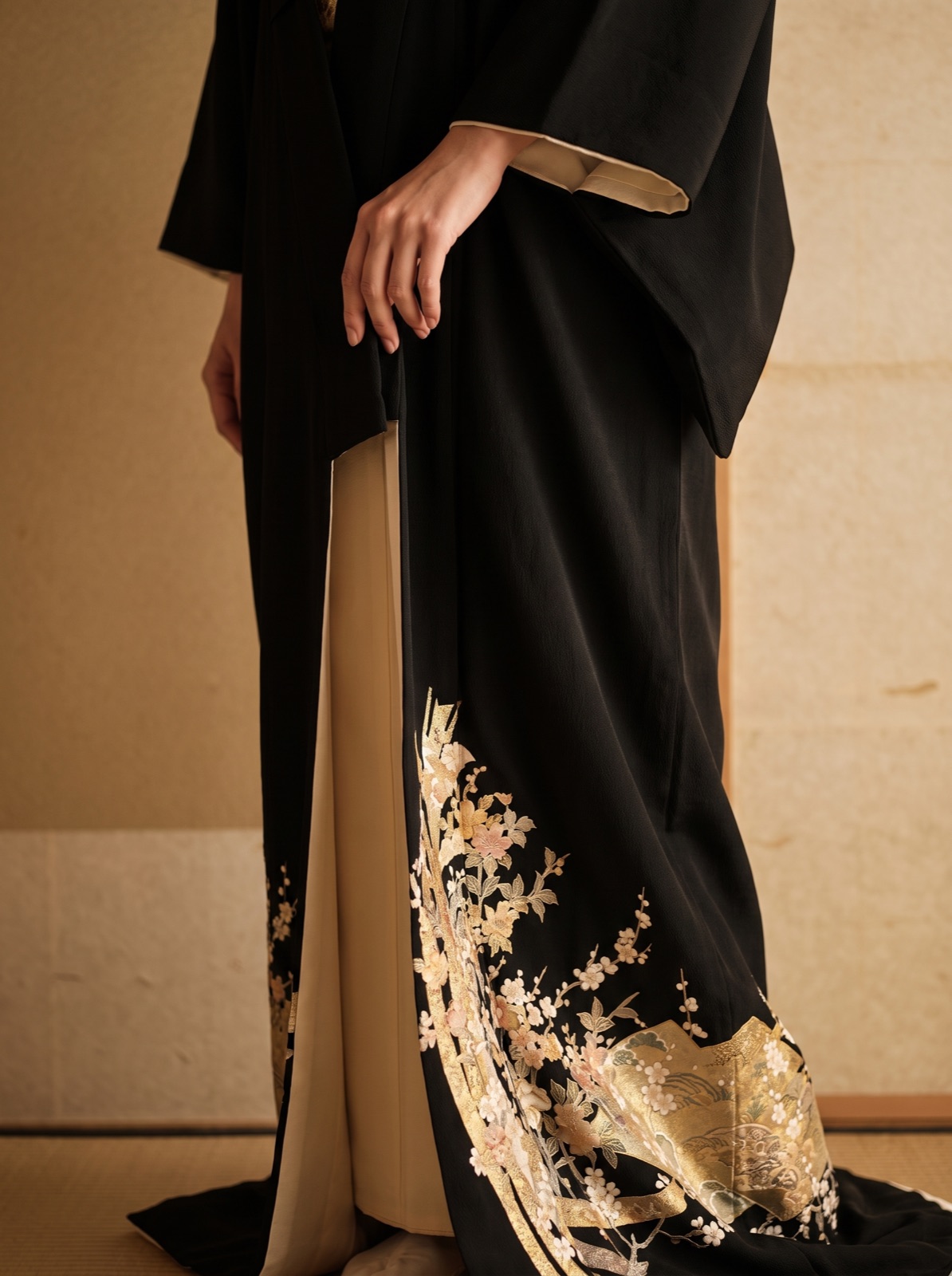
- Black on black is the base. Black-ground kimono such as the kurotomesode pair well with the classic abaya colour, and only the patterned section speaks, quietly.
- Keeping the layer underneath plain lets the pattern stand out. With an open abaya, the length and colour underneath can bring a sense of season.
- For a hijab or shawl, picking up one colour from the abaya’s pattern pulls the look together (→ About the kimono hijab).
- From formal occasions to everyday. The kimono robe can be enjoyed simply as an overlayer, even when modesty is not the aim.
On the runway — Doha, Qatar
In November 2023, a kimono robe walked the runway at the “Future Fashion & Technology — Sustainable Fashion Show” in Doha, Qatar, presented by Goshopia, our partner ethical-fashion store in Dubai. You can watch the actual runway moment below (video courtesy of Goshopia).
About semi-custom
While keeping the character of a one-of-a-kind cloth, the length, sleeve length, front closure and button positions can be adjusted to your build and use. What we can accept varies with fabric stock and pattern, so please ask first. Production takes time (see the guide below).
▶ Ask about semi-custom → Contact
Where to buy a kimono abaya / kimono robe
WATASI JAPAN’s kimono robe — long wear in abaya and robe forms, made from the kurotomesode and other vintage kimono — is available in the official online store.
▶ See the kimono robe (official store)
- Price range: ¥45,000–¥70,000 (tax included, one of a kind). Long kurotomesode pieces are around ¥60,000–¥70,000; robes from other vintage kimono are mostly ¥45,000–¥50,000.
- Production time: because each piece is tailored individually, it may take around 2–4 weeks
- Ships to more than 50 countries
- Also available at stockists → Stockists (HALAL-Ya, Asakusa / JAPANeid, Osaka)
Chosen by people who —
- are looking for a properly composed abaya that completes a look on its own
- want a robe or gown in a good material, not a mass-produced one
- want to wear something with respect for Japanese culture and craftsmanship
- are looking for a gift for someone dear (→ A guide to gifts for Muslim friends)
About WATASI JAPAN
WATASI JAPAN is a Fukushima brand that makes Japanese modest fashion from vintage kimono, under the concept “Wear Japanese Art.” It has been introduced to 150 countries on NHK WORLD and covered by the Nikkei and others, and with support from JETRO is expanding into the Middle East, beginning with the UAE.
→ WATASI STORY / Modest fashion and WATASI JAPAN / Craftsmanship